
How Bowling Lanes Are Oiled:
Understanding Lane Patterns and How They Affect Your Bowling Ball
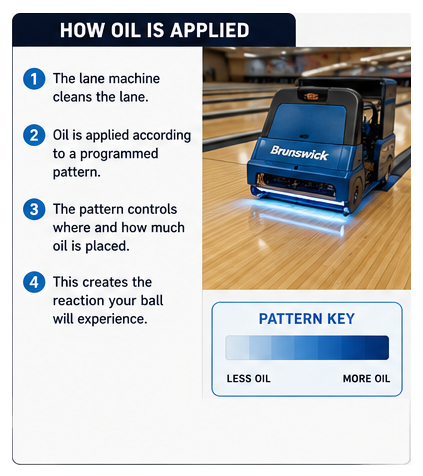
If you've ever thrown what felt like a perfect shot only to watch your bowling ball hook too early, skid past the pocket, or refuse to turn at all, the problem may not have been your technique—it may have been the lane.
One of the biggest differences between recreational bowling and competitive bowling is lane oil. Every bowling lane is coated with a carefully designed oil pattern that changes how your bowling ball reacts. Learning how these patterns work can instantly make you a smarter and more consistent bowler.
Why Are Bowling Lanes Oiled?
Many new bowlers assume lane oil is there simply to make the lane slippery. While that's partly true, oil serves several important purposes:
- Protects the wooden or synthetic lane surface from damage.
- Creates consistent playing conditions.
- Controls how quickly bowling balls hook.
- Allows bowling centers to offer different levels of difficulty for leagues and tournaments.
Without oil, bowling balls would grip immediately, creating excessive hook and damaging the lane surface over time.
Understanding Oil Pattern Length
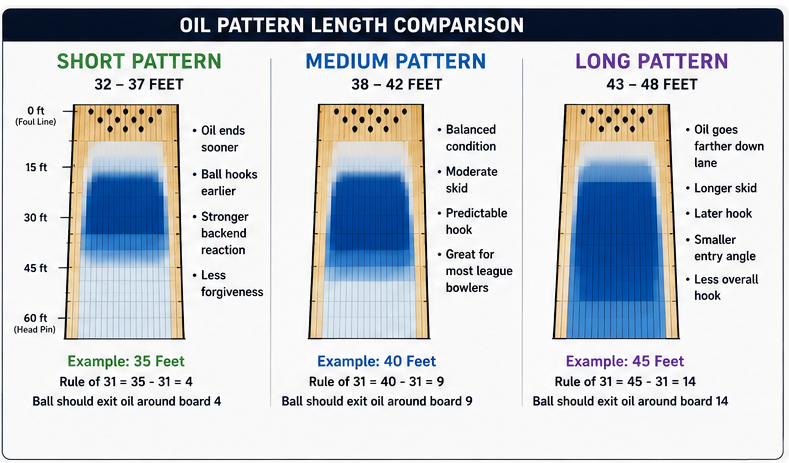
One of the easiest ways to estimate where your bowling ball should begin hooking is called the Rule of 31.
Take the length of the oil pattern and subtract 31.
Example:
- 35-foot pattern
- 35 − 31 = 4
This means the ball should ideally exit the oil around board 4 before making its move toward the pocket.
While it's not a perfect rule, it's an excellent starting point.
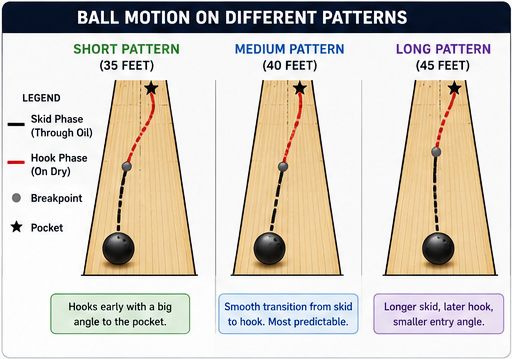
Short Oil Patterns (32–37 Feet)
Characteristics
Short oil patterns leave much of the back end of the lane dry.
This allows the bowling ball to encounter friction earlier and hook aggressively.
Ball Motion
- Earlier hook
- Strong backend motion
- Larger angle into the pocket
- Less forgiveness
Best Strategy
Most bowlers play farther outside because the dry boards create more friction.
Common adjustments include:
- Standing farther right (for right-handed bowlers)
- Using smoother equipment
- Reducing ball speed if necessary
Common Challenge
If your ball hooks too early, it can cross over the head pin or leave difficult splits.
Medium Oil Patterns (38–42 Feet)
These are the most common league conditions.
Characteristics
Medium-length patterns provide a balanced reaction.
Ball Motion
- Moderate skid
- Controlled hook
- Predictable backend
Best Strategy
Most league bowlers find success playing somewhere between the second and third arrows.
These patterns reward consistency more than extreme power.
Long Oil Patterns (43–48 Feet)
Long patterns contain oil much farther down the lane.
Characteristics
Because the ball stays in oil longer, it has less time to hook before reaching the pins.
Ball Motion
- Longer skid
- Later hook
- Smaller entry angle
- Less overall backend
Best Strategy
Players often move deeper inside the lane and create angle using stronger bowling balls.
More surface on the bowling ball can also help create traction.
House Shot vs. Sport Pattern
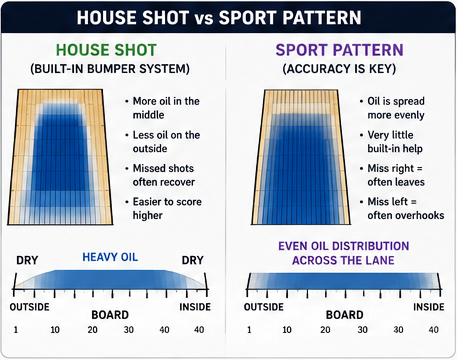
One of the biggest differences in bowling is understanding house shots and sport patterns.
House Shot
House shots are designed to help bowlers score.
They feature:
- More oil in the middle
- Less oil toward the outside boards
This creates what bowlers call a built-in bumper system.
If your ball drifts toward the gutter, the dry boards help it recover.
If it misses slightly inside, the heavier oil slows the hook.
This makes strikes much easier.
Sport Patterns
Sport patterns are designed to reward accuracy.
Instead of creating free hook outside, the oil is distributed much more evenly across the lane.
Miss right:
- Ball may never recover.
Miss left:
- Ball hooks too early.
There is very little room for error.
This is why averages often drop 20–40 pins when bowlers compete on sport conditions.

Understanding Oil Volume
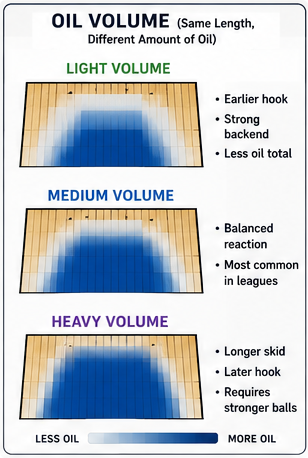
Not all oil patterns contain the same amount of oil.
Some patterns are:
Light Volume
- Earlier hook
- Strong backend
- Easier for weaker balls
Medium Volume
- Balanced reaction
- Most common league condition
Heavy Volume
- Longer skid
- Requires stronger bowling balls
- Surface adjustments become more important
The same 40-foot pattern can play very differently depending on the amount of oil applied.
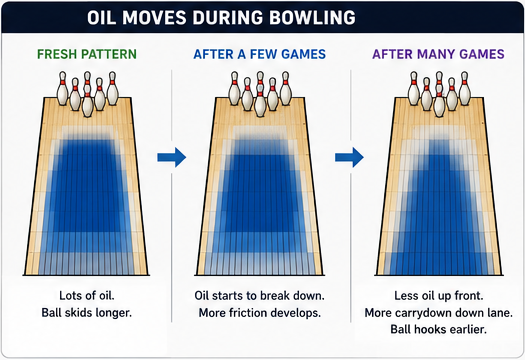
Oil Moves During Bowling
One thing many bowlers don't realize is that the oil pattern changes every frame.
As bowling balls travel down the lane they:
- Pick up oil.
- Carry oil farther down the lane ("carrydown").
- Remove oil from certain areas ("breakdown").
After several games, the lane no longer plays like it did at the start.
Experienced bowlers constantly adjust by:
- Moving their feet.
- Changing their target.
- Adjusting ball speed.
- Changing hand position.
- Switching bowling balls.
Reading these lane transitions is one of the biggest differences between average bowlers and advanced competitors.
Choosing the right ball
Different oil patterns require different bowling balls.
| Lane Condition | |
|---|---|
| Dry | Smooth reaction with polished equipment or weaker coverstocks |
| Medium | Benchmark ball with predictable motion |
| Heavy | Stronger coverstock with more surface to create traction |
Many competitive bowlers carry six or more bowling balls so they can match the equipment to changing lane conditions.
Tips for Reading Lane Conditions
Watch how your ball reacts.
Ask yourself:
- Did it hook too early?
- Did it skid past the breakpoint?
- Did it hit the pocket weakly?
- Did it overreact off the dry boards?
Small adjustments often make a huge difference.
Moving just two boards with your feet can completely change your ball reaction.
Common Bowling Oil Patterns
Some of the most recognized competitive oil patterns include:
- Cheetah Pattern – Short, quick hook.
- Wolf Pattern – Medium-short with controlled backend.
- Scorpion Pattern – Balanced and versatile.
- Chameleon Pattern – Requires frequent adjustments.
- Shark Pattern – Long and demanding.
- Bear Pattern – Longer volume requiring patience.
Each pattern challenges bowlers in different ways and emphasizes adaptability rather than simply throwing harder.
Final Thoughts
Learning how bowling lanes are oiled can dramatically improve your game. The oil pattern determines when your bowling ball skids, where it begins to hook, and how it enters the pins. Understanding pattern length, oil volume, and lane transition allows you to make smarter adjustments instead of guessing why a shot didn't work.
Whether you're bowling in a weekly league, preparing for a tournament, or simply trying to increase your average, understanding lane conditions is one of the fastest ways to become a more confident and consistent bowler. Instead of fighting the lane, learn to read it—and let the oil pattern become another tool you use to strike more often.